|
|
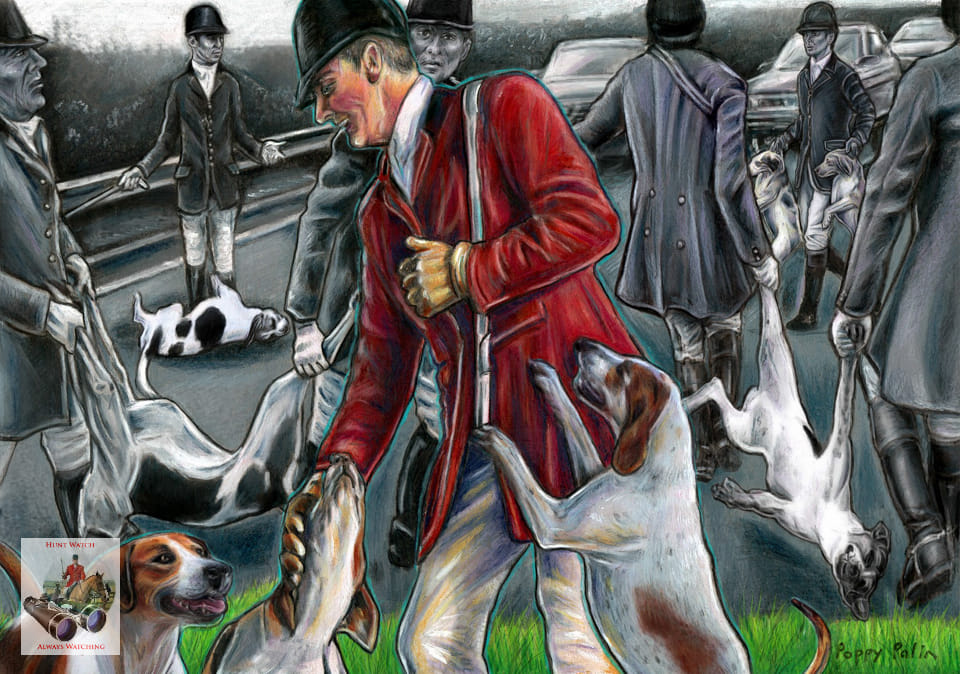
| 'Public face, private hell' [by Poppy Palin, @palinpoppy. Commissioned by Hunt Watch.] |
PAGE CONTENTS 1. CALCULATIONS
FOR NUMBERS OF HOUNDS KILLED ANNUALLY BY HUNTS 2. PICTURES THAT TELL A THOUSAND WORDS 3. HYDATIDOSIS - A HUMAN DISEASE THAT HOUNDS CAN TRANSMIT 4. ''IT'S
A DOG'S LIFE' - IMAGINED RETELLING OF THE LIFE OF A HUNTING HOUND 5. POST-MORTEM
FINDING IN IRISH CULLED HOUNDS, 2011 1.
CALCULATIONS FOR PROBABLE
NUMBERS OF HOUNDS DELIBERATELY KILLED BY HUNTS EACH YEAR IN THE UK
SUMMARY My
examination and analysis of the data available to me regarding numbers and types of organised Hunts in the UK, numbers of
hounds in each, numbers of pups bred per year and numbers in particular categories, has led me to conclude that the numbers
of hounds deliberately and unnecessarily killed by their own Hunts per annum in the UK is probably somewhere between 4,942
and 7,302. INTRODUCTION Understandably, Hunts are extraordinarily reluctant to discuss, or let
any outsider see, the brutal realities behind their turnover of hounds, let alone the sheer scale of their annual extermination
programmes of surplus, deficient, miscreant and superannuated hunting dogs. It is not exactly compatible with the images of
love and devotion of Hunt staff towards their hounds that they like to have filmed when trying to defend their ‘sport'
from attack. I would not allege that hunting hounds are routinely mistreated during their working lives, though it
is clear that miscreants often receive pretty harsh punishment and 'rating'. Nor do I imagine that many, if any, kennel
staff are entirely devoid of normal human feelings, much as encountering some of them in the hunting field might well make
one think so. They must surely develop some tender feelings for their charges? Whether or no, they are, nonetheless still
willing to collude with, participate in or actually conduct regular executions of numbers of perfectly healthy hounds - to
serve a wholly unnecessary and selfish purpose. Little wonder then that anti-hunt campaigners regard the 'crocodile tears'
shed so often by hunters with a degree of scepticism, if not outright contempt.
DATA, SOURCES, ANALYTICAL
PROPOSALS Brian Fanshawe, of the Campaign for Hunting was, however, asked some questions about the subject of hound
'culling' by the Burns Inquiry. What he told them was, it appears, mostly correct, as far as it went. Which was not
very far, since his questioners clearly lacked either the knowledge or the will to subject him to any truly revelatory inquisition.
Inadvertently or otherwise, this left the impression that the number of hounds deliberately killed by UK Hunts each year is
markedly lower than it actually is. One thing Mr. Fanshawe said conflicted with what had previously been accepted as
a given in anti-hunt discourse about hounds, and stated definitively as fact by perhaps the greatest ever avowed hunting authority,
G.F. Underhill. In his magisterial tome 'A Century of Fox Hunting' [1900] he avers that 'the average life in the
hunting field is five seasons1 - NOT the 'six or seven' suggested to the Inquiry by Mr. Fanshawe. Underhill
agrees they are entered at 18 months. So, according to him, hounds are usually 6 - not Fanshawe's 7 or 8 - when they are
'retired' [usually with a bullet to the head as pension]. It is true that evidence from former professional Huntsman,
turned 'anti', Clifford Pellow2 does also lend support to the idea that 6-7 seasons in the pack is closer
to the modern norm. However, hunting with hounds is perhaps the most conservative and tradition-conscious of all 'sports'
and I find it rather hard to believe that something as radical as increasing the hunting life span of hounds by 20-40% occurred
in the intervening century at all, let alone without much in the way of visible comment. I intend, therefore, to perform
two separate sets of calculations, using different base data for each, since I cannot be certain which is more accurate. According
to the Master of Foxhounds Association website today there are 174 foxhound packs affiliated to them in England and Wales
and a further 10 in Scotland. There are 8 Fell packs in Cumbria not so affiliated and a further 3 fox hunts in Ulster affiliated
to the Irish Association. So there are 195 foxhound packs in the UK at present. I know of a further 114 Hunts of other types,
all registered [except for 2 roe deer hunts in SW England]. This figure does not include the significant number of gun packs
[aka Fox Destruction Clubs] which exist, principally in Scotland and Wales. There are hardly any published data about these,
not even their numbers, and little is known about the numbers of hounds they own or how they deal with them. They are thus
excluded from this paper completely. In 2003, in a question in the House of Lords3, hunting peer Earl Ferrers
gave some specific figures on organised Hunt hound numbers, which were presumably authoratitive. His figure of 11,766 entered
foxhounds in the UK appears to refer to MFHA affiliated packs only, and is highly compatible with the average which I have
derived from my own research. With one exception, which I will address later, we can, therefore, presumably trust his
figures on the numbers of non-foxhound hounds in other Hunts. To Ferrers' 11,766, we can add 420 foxhounds in Fell packs
and about 190 in Ulster packs to reach a figure of 12,376 for all UK foxhound packs, giving an average of fractionally under
63.5 per Hunt. This is virtually identical to my own separate calculation of average 'entered' hound numbers for foxhound
packs from modern data published by individual Hunts. Crucially, though, Underhill goes on to say that 'however
careful an MFH may be in breeding hounds, only half the whelps will eventually be of any use in the hunting field.' Ever
since in 1984, Captain MacKenzie, MFHA Chairman, said that the average fox hunt breeds 36 pups per year, this statement has
formed the basis of anti-hunt groups attempts to estimate the number of hounds 'culled' by Hunts. The Captain was
a highly authoritative figure and it is difficult to believe he could have been very far wrong. But It is also very hard to
reconcile McKenzie's figures with ones published more recently, which are around half or less in number. Whilst
there may have been some reduction in the apparent cavalier wastefulness among fox Hunts of their hounds at both ends of the
age spectrum since 1984, this seems unlikely to account for such a large variation, even allowing for a likely post-ban dip,
so it is very hard to know in which statements to place the greater credence. In 2004, the House of Commons All Party
Group on Animal elfare [APGAW] report on the welfare of hounds post ban [which severely overestimated the impact it would
have on Hunts] cited canine behaviour and welfare experts Casey & Blackwell as having concluded that 3,412 fox hound pups
were born annually in the UK, giving an average of around 19 per Hunt, though the source and derivation of this conclusion
is unknown to me. The APGAW report also asserted that 'For ethical reasons, the Group believes that no healthy
dog should be put down unless absolutely all other options have been exhausted.' I believe most people would agree with
this sentiment and, hopefully, all of those who purport to be 'dog lovers.'. Following the Hunting Act 2004,
and the consequent uncertainty, reported numbers bred initially dipped but appear to have been recovering strongly since,
and may well have done so even more in the last couple of years, with the expectations of repeal of the Hunting Act high. The
latest figure I have seen is that given by Alistair Jackson of the Hunting Office for 2007 - 2,749, reducing the average per
Hunt further to around 15. This latter figure, however, hardly seems credible, since, if all MFHA fox hunts are included,
it barely covers replacement of 'retired' hounds, let alone those lost pre- and post- entry due to illness, accident
and unsuitability to hunt. It is surely well below the level fox hunts would aim for if the Hunting Act were to be repealed.
How to handle these discrepancies? The Jackson figure seems unfeasibly low, even for 2007, and numbers may well have
increased significantly since then. I therefore intend to disregard it. Even though it is a little older, Casey & Blackwell's
figure of 19 pups/Hunt/year seems likelier to be nearer the current actuality, so I shall use that as a base datum for my
primary calculations. I shall, however, perform a separate calculation employing Capt.McKenzie's 36 pups/hunt/year assertion,
and the traditional allowance of 5 hunting seasons per hound.
CALCULATION 1 EMPLOYING THE DATA
FROM FANSHAWE AND OF CASEY & BLACKWELL. If the average fox hound pack 'entry' is 63.5 strong,
and the average hunting life is 6.5 seasons, then an average of 9.7 hounds will be required annually to replace 'retirees'.
Note that if this is correct, then 9.3 pups per Hunt do not make it to the 'entry'. This would appear to indicate
that Underhill's assertion that only half the 'whelps' will prove 'of use in the hunting field' is as
true now as it was then. - and perhaps also suggests that, if these figures are correct, fox Hunts are leaving little margin
for error in their breeding programmes. This is rather in contradiction to a policy advocated by the 8th Duke of Beaufort,
who, writing of another Master said 'the secret of his success was to breed a great many and put down a great many.'
['Hunting', 1906]. An average of 9.7 pups per pack should be needed to replace 7/8 year old 'retirees'.
195 Hunts x 9.7 gives a total of only 1,892 annual 'vacancies' for fox hunts. But Brian Fanshawe, of the Campaign
for Hunting told Burns that 3,000 are 'to be entered'.annually. He admitted that nearly all of those ‘exiting'
are killed by the Hunts. There are 3 possible explanations I can think of for the discrepancy between the lower figure
[1.892] and Fanshawe's 3,000, though these are not necessarily mutually exclusive:- 1/ Fanshawe's 'to be
entered' includes hounds that, for whatever reason, get no further than their first cubbing, with some, possibly most,
of these failing this 'entry exam' and being 'drafted' - presumably by being killed. 2/ The average
'retirement' age is actually significantly less than 7/8. Other stats, seem to militate against this, but this may
raise questions about their accuracy. Certain casual statements made by hunt supporters in the last 25 years would seem to
support the lower age estimates for 'retirees'. Indeed, in 1997 one supporter reportedly said that hounds at his Hunt
were killed at around 5 years of age.4 3/ It may also include hounds used to replace any entered [pre-'retirement']
hounds of all ages who die following accident/illness/misadventure, or who are executed for any number of 'crimes'
each year [rioting, babbling, running mute, etc] or allowed some non-lethal form of 'drafting', But, in the context,
this seems unlikely. All or most such 'casualties' would occur at times of year when there are no 'pre-entry'
hounds around suitable to act as replacements, not being old or experienced enough. So, the pack strength would probably only
be restored during the next refurbishment. Each season's total is, then, additional to the numbers already calculated.
There are a postulated total of 1,892 ‘vacancies' per year. Mr. Fanshawe's 3,000 'To be entered'
leaves 1,108 unaccounted for, who never make it as far as the pack. Fanshawe suggested as many as 340 hounds are drafted overseas
or to drag packs. Frankly, as an annual average, this number does not seem credible to me. This was at a time when a pretty
draconian ban was in the offing, so Hunts may have been more willing than usual to offload any 'surplus' hounds and
there may have been more willing recipients. So let us deduct, say an average of just 200 from the annual discrepancy, reducing
it to 908. BUT Fanshawe offered the Burns Inquiry no figures either on how many hounds are bred, or how many might be
killed between birth and entry - because he wasn't asked. Still, a certain proportion of the pre-entry
cohort will inevitably perish through accident/illness, but, in these days of advanced veterinary medicine, and, given that
they are no more than 18 months old and will have been mostly in the care of experienced 'puppy-walkers', the numbers
seem likely to very low. But let's allow a generous-seeming 5% of the remainder to this category. 5% of 908 = 45, and
908 - 45 = 863. Former Hunstman Clifford Pellow once confirmed to me in a conversation in the early ‘90s that
the number of pre-entry hounds killed by Hunts is considerable and that the 'culling' process starts immediately after
birth - including, he said, dashing out the brains of neonates who are malformed, or deemed unsuitable in any other way, on
the concrete kennels floor. ‘After all' he said to me ‘a bullet costs 10p.'. And, if the Hunts
don't kill the hounds that don't make it to the pack, where are they? Not walking round on leads as pets - we'd
all have noticed that. With an average life expectancy of say, 12 years, there should be many thousands of them around at
any one time. Anyway, Hunts always claim that their hounds are not suitable for domestication, even maintaining it would be
'cruel' for them. Obviously, Hunts would never be cruel, would they? It being hard to account for this residuum
any other way, I will assume that, like the 'retirees', they are indeed deliberately killed. We therefore have a running
total of 1,892 'retirees' + 863 pre-entry hounds = 2,755. To this number we must, however, add a proportion
of the 'entry' who, during their planned six or so year stint with the pack, either become unable to hunt through
some non life-threatening injury, or illness or are deemed guilty of faults that make them unsuitable to continue, such as
the 'crimes' mentioned above. This is a more imponderable number. I will again be conservative and assume that an
average of just 4 in every 100 hounds are thus afflicted each year [less than 2.5 per pack/year]. We've established a
figure of 12,376 entered foxhounds in the UK. 4% of 12,376 = 495. Our running total of deliberately killed hounds is
now 2,755 + 495 = 3,250. BUT these figures are for registered foxhound packs only. Earl Ferrers
told the Lords in 2003 that, besides 11,776 entered foxhounds in, it appears he meant, MFHA affiliated Hunts, there were 9,271
other hunting hounds with registered packs in the UK. Some of these are also foxhounds that have been included in the above
calculations. 610 are those from the Fell and Ulster Hunts, reducing the total for further calculation to 8,661. This
includes a figure of 3,000 for 'unentered hounds' which Ferrers added at the end, reducing the total of 'entered'
non-foxhounds further to 5.661. This 3.000 being the same number as Fanshawe's MFHA-affiliated 'to be entered'
foxhounds is too much of a coincidence. They must surely be the same. Thus it appears that the Earl neglected to include the
number of unentered hounds in non-foxhound packs, which number needs to be added to the running total. In the absence
of data, or information to the contrary, it seems reasonable to assume that breeding rates and allied practices are much the
same in foxhound and non-foxhound Hunts. There is something of a discrepancy between Ferrers' residual figure of
5,661 for non-foxhound packs and the results of my own recent examination of data from these Hunts. This suggests the average
is 58 per Hunt. There should then be a total of 6,621 entered hounds. Let's split the difference and call it 6,141.
So, if 12,376 entered foxhounds require 3,000 'to be entered' pups in any one year, almost exactly half this number
of entered non-foxhounds should require fractionally overhalf this number; 1,503. I will now apply the same calculations
to the non-foxhound packs as we did to the foxhound ones above, and in proportion. There are 114 Hunts with an average
pack size of 58. If, like foxhound packs, they 'retire' hounds after 6.5 seasons on average they will require an average
of 8.9 hounds per pack as replacements. 114 Hunts @ 8.9 per Hunt = 1,015. If they have 1,503 hounds 'to be entered'
then 488 are unaccounted for.
Let us now apply the same calculations to this as we did above for foxhounds. - Deduct
-Drafting of pre-entry to overseas and drag packs seems likely to be proportionately less than for foxhound packs. Say 60
per year. This leaves 428.
- Deduct 4% lost to illness/accident, etc. 4% of 425 = 17, leaving 411.
- Add back
4% of entry killed due to disability or 'crimes'. 4% of 6,141 = 246, making, 677.
The total for numbers
presumed deliberately killed is, then, 1,015 'retirees' + 677 = 1,692. Add this to the number of foxhounds believed
deliberately killed and the figure is 3,250 + 1,691= 4,942
CALCULATION 2
ACCEPTING MCKENZIE AND UNDERHILL'S ASSERTIONS . So, MacKenzie's per hunt 36 pups x 195 fox hunts = 7,020
hounds, and 7.020 - 3,000 [the ‘entry'] = 4,020 pups unaccounted for. If,
however, the average life of an entered hound is only 5 seasons, then a larger number are required as replacements. 63.5 hounds
per pack/5 = 12.7 hounds, x 195 Hunts = 2,476. This leaves a startling 4,544, unaccounted for, or 23.3 per Hunt.
Deduct hounds drafted to foreign and drag packs. Given the larger surpluses in this scenario, Fanshawe's
340 figure seems more likely as a regular average, so let's use that. 4,544-340 = 4,204. Deduct.
4% lost to illness/accident etc. 4% of 4,204 = 168, and 4,204 - 168 = 4,036 Add back 4%
of entry killed due to disability or 'crimes'. 4% of 12,376 = 495, and 4,036 + 495 = 4,531
Again,
these figures cover only MFHA affiliated fox hunts. There are figures from the 114 non-foxhound Hunts to add on. These
have an average 58 entered hounds, so the replacement number for 'retirees' needed is 58/5 = 11.6 per pack. The total
is 114 x 11.6 = 1,322. The number of pups born per annum per hunt, assuming again that they follow the same practices
as fox hunts, is 36 x 114 = 4,104, so the number unaccounted for is 4,104 - 1,322 = 2,782. Deduct
hounds drafted to foreign and drag packs. Again, given the larger surpluses in this scenario, it seems reasonable to take
a pro-rata figure based Fanshawe's 340 for foxhound packs. Say 171, and 2,782 - 171 = 2,611 Deduct.
4% lost to illness/accident etc. 4% of 2,611 = 104, and 2,611 - 104 = 2,507 Add back 4%
of entry killed due to disability or 'crimes' . 4% of 6.612 = 264, and 2,507 + 264 = 2,771
The number
of foxhounds deliberately killed by Hunts can now be added to the number of non-foxhounds - 4,531+ 2,771 - to give the overall
total in this scenario:- 7,302.
CONCLUSIONS As ever, with such
calculations, the final totals depend upon the statistical evidence relied upon and assumptions made. I am as certain
as I can be of the figures regarding numbers of entered hounds used in both sets of calculations above and I have deliberately
been conservative where I have made estimates of the numbers of hounds likely to be or be killed for particular reasons. For
the purposes of quoting, and further analysis, by campaigners in England and Wales, it should be remembered that the totals
include Scottish and Ulster Hunts. These are, though, a very small proportion of the total. The Hunting Act 2004 applies,
of course, only to England and Wales and, these days, it is mostly hunting in these areas that we talk about. Whichever
critical statistics considered above are the more accurate, we should be on defensible ground if we quote figures of between
about 5-7,000 hounds deliberately killed by all registered UK Hunts per year, and about
3,250-4,500 for English/Welsh registered fox Hunts.
Alan Kirby,
M.Sc, Associate of Protect Our Wild Animals [POWA] 21-12-2011FOOTNOTES 1. "A hound begins to hunt at 18 months..... and his average life in the field is five seasons..:
therefore at least 20% of the full strength of the pack must be entered annually to fox..... it is our experience that, however
careful an MFH may be in breeding hounds, only half the whelps will eventually be of any use in the hunting field."
G.F.Underhill, 'A Century of English Fox Hunting' [1900] 2. The former professional
huntsman of the Tredegar Farmers Fox Hounds, with 40 years experience as a hunt servant, who resigned in the early ‘90s
because he could not persuade the Masters that the Hunt should desist from various cruel malpractices. He actually had a change
of heart about hunting altogether, and told his harrowing and revelatory story to the League Against Cruel Sports [published
as 'A Brush with Conscience' 1991]. One of the Hunt Masters, Howard Jones, sued him for libel and lost, at a cost
of at least £100,000. 3. House of Lords, 16-9-03 Earl Ferrers:
'My Lords, I am grateful to the Minister for that astonishing reply. Does he not realise that if the Bill becomes
law 11,766 foxhounds, 3,600 beagles, 1,200 harriers, 511 mink hounds, 420 fell hounds, 220 deer hounds, 300 basset hounds
and 3,000 unentered hounds will be destroyed because there will be nothing for them to hunt? Is not the noble Lord ashamed
of that?'
Lord Whitty: 'My Lords, that adds up to roughly
the 20,000 to which I referred, several thousand of which in practice are destroyed every year because they outlive their
usefulness or their ability to join the pack. Therefore, it is not unusual for hunts to destroy hounds..... ' 4. In the late ‘90s, a journalist wrote an article for the Independent newspaper, after going
out with the Vale of White Horse hunt, in which he stated: "When Mr Bailey's [the professional Huntsman]
pack reaches retirement age, usually about 5 years old, he shoots it and feeds it to the others. This practise, according
to a hunt aficionado, is apparently to ‘give the hound one last run'. In the stomach of his chums." Jim
White on the VWH, 14 February 1997.
The supporter may or may not have been fantasising
or spinning the journo a line about the feeding. Naturally, Mr.Bailey denied it and even challenged the journalist's account
of what he'd been told, but Mr. White stuck to this. Whether this practice actually ever happened at the VWH or not, I
am personally disinclined to believe it is common in hunt kennels and there is no real evidence I know of to support
its existence at all. The reality of how we know redundant hounds are dealt with is bad enough without having to postulate
further horrors.
Quite why the VWH supporter would have suggested hounds are 'retired'
at around 5 if the reality is 7/8 is, however, another matter.
2.
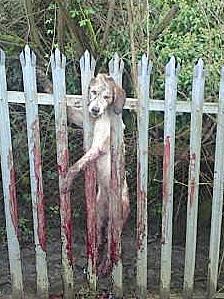 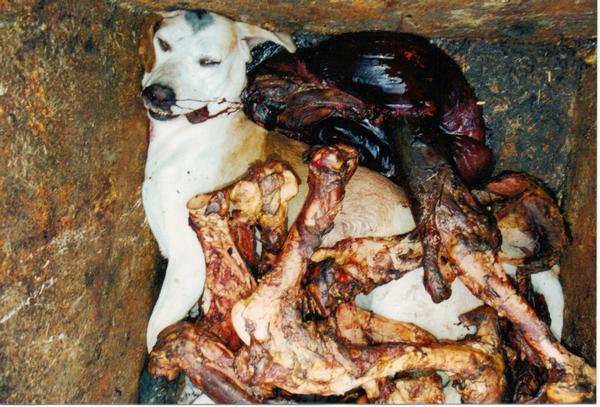
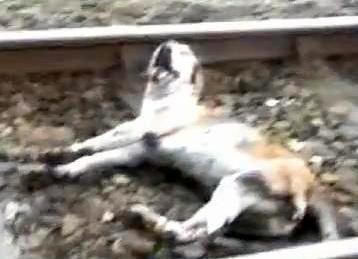 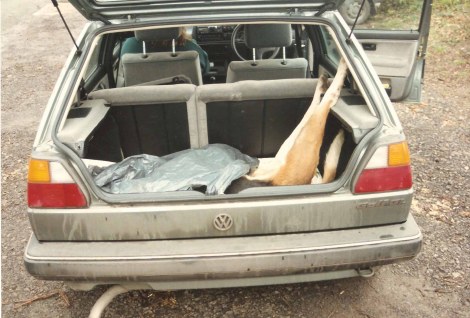
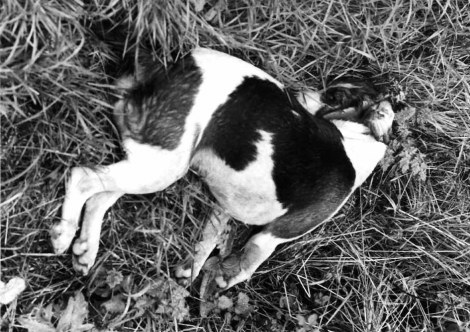 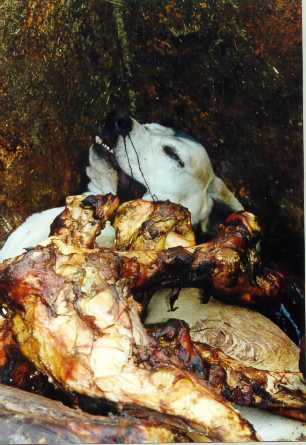 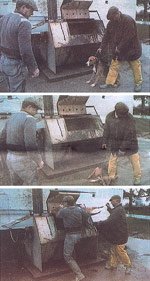 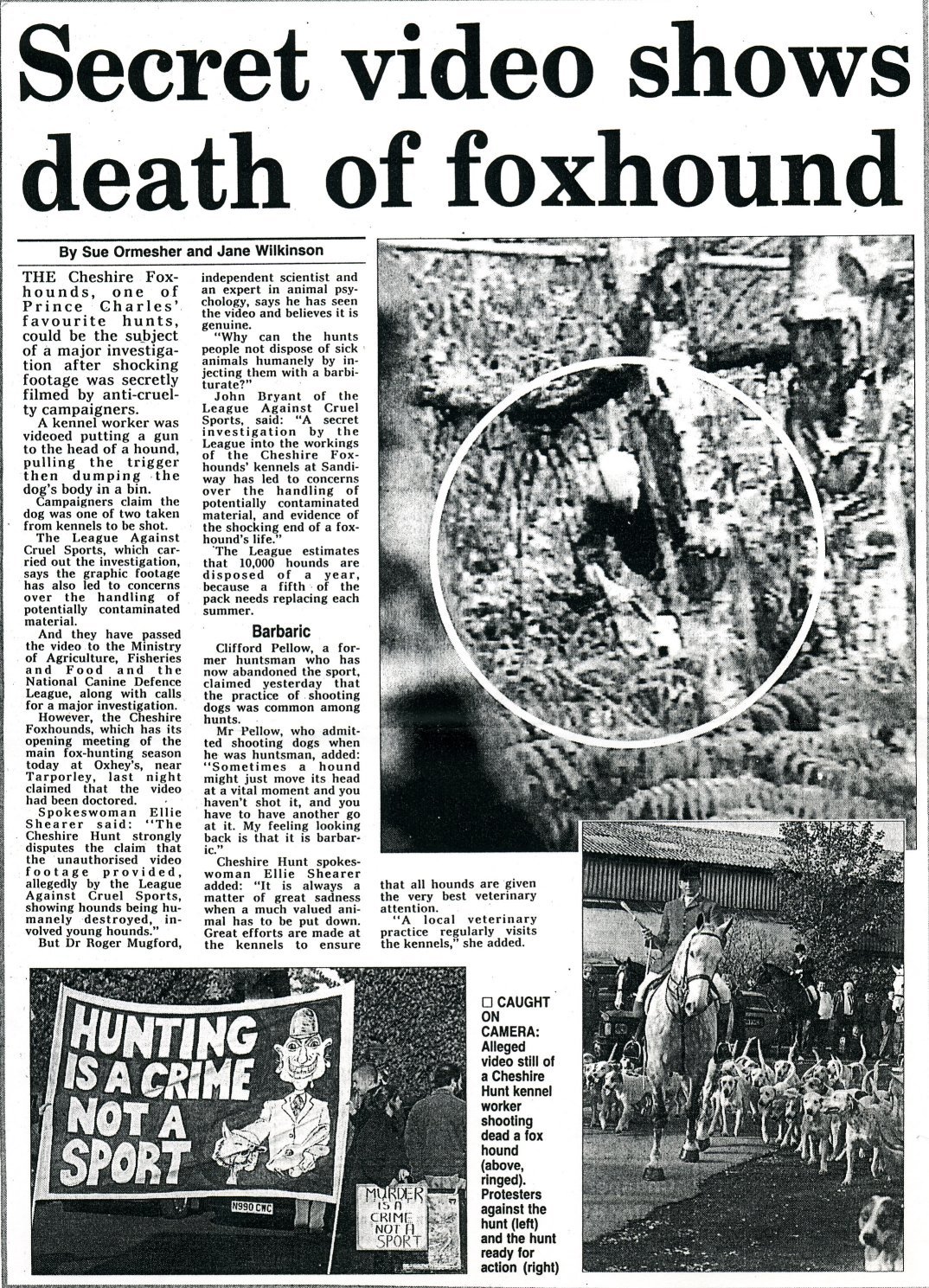
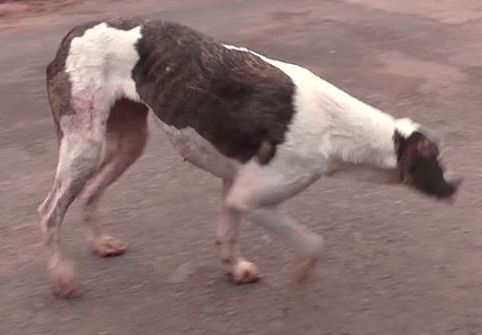
| Melbreak FH hound December 2014 |
|
3.
HYDATIDOSIS - A HUMAN DISEASE
THAT CAN BE PASSED ON BY HUNTING HOUNDS
The report on hydatidosis dating from 1993 below, which was as accurate as I could make it then, should be read in
conjunction with the extracts from 2010 reports from DEFRA and NHS Wales appended to it. These make it clear that
UK incidence rates of hydatid infection in both humans and sheep have dropped dramatically in the last 20 years. Clearly,
most of the statistics in the 1993 report are no longer valid and shouldn't be quoted as though they were. This does not,
however, mean there is no longer any risk of people acquiring the disease from contact with hounds as it is far from clear
that best practice regarding the feeding and worming of hounds is anywhere near universal in hunt kennels. Alan Kirby, 13-11-12 ------------------------------------------------------------------------------------------------------------------------
RELATIONSHIPS AND EFFECTS OF TAPEWORM INFECTION IN DOGS AND HYDATID CYSTS IN RUMINANTS AND MAN Introduction Hydatid
cysts, which are potentially fatal in humans, result from infection of ruminants and man by ingestion of the eggs of a tapeworm
that is carried by dogs fed on uncooked offal from ruminants. The disease resulting therefrom is known as hydatidosis
or echinoccocosis.
This is not, as has been stated elsewhere, caused by the tapeworm taenia
hydatigena. The latter is spread by dogs to sheep and, sometimes, to pigs. It rarely causes serious infections in sheep,
though infected lambs may show some unthriftiness. It does occasionally cause traumatic hepatitis in lambs, leading to death.
It may also cause fibrotic tracts and cysts in sheep livers, leading to condemnation of the latter post-slaughter. It is not
infective to humans [1]. It can even serve a useful function to sheep, immunizing them against liver fluke - as long as the
infection occurs at least 12 days before the liver is challenged by the fluke [2].
Only 2 species of taenia,
T.multiceps and T.seralis are implicated in human disease in temperate climates. Both can cause cerebral infections in man,
but this is very rare [3].
The cause of hydatidosis The infectious agent in hydatidosis
is the larval stage of the tapeworm Echinoccocus grandulosus [4] - henceforth referred to as E.g. E.g.
eggs are almost identical to those of T.hydatigena. To diagnose which tapeworm a dog is carrying it is necessary to purge
the animal to obtain samples of the adult phase. Even then, microscopic examination is needed to distinguish between the two
tapeworms [5]. The parasite has a cosmopolitan distribution [6], but is most commonly found in areas with high densities of
sheep. It also has a high biotic potential, leading to the expression of mutants or strains [7].
There are currently
two main strains of E.g. in the U.K. One involves passage between horses and hunting hounds. It is found in the eastern
counties of England. It does not infect humans or sheep [8] and appears not to have any serious effects on equines. The other
strain is found in the west and is particularly common in Wales. This passes from dogs to sheep [and other ruminants] and
back, and sometimes to man [9].
How infection occurs
By far the principal vector for
the infection of dogs with E.g. is feeding on the raw viscera of herbivores [10], though E.g. can survive inadequate
cooking. Canine hosts carry large parasite burdens and help to contaminate the environment with large numbers of eggs in their
faeces [11]. The highly resistant eggs can remain alive for 2 years and more on sodded pastures were there is sufficient moisture
[12]. In some areas foxes may be infected [13].
When ingested, the eggs develop into the larval stage [metacestode].
This phase is the important part of the life cycle so far as pathogenicity is concerned. The eggs ingested by the host [man,
most ruminants, pigs, rabbits] grow protective membranes in the form of cysts [14].
E.g. is especially important
as a parasite because of the prevalence of dangerous hydatid cysts in people who live in close association with dogs whose
food consists of parts of the carcasses of animals which serve as intermediate hosts [15]. Infection often takes place in
childhood through eggs on the hands from fur of infected dogs or who have rolled on infected ground [16]. However, humans
can also be infected from contaminated water and vegetables, and, perhaps, also indirectly from coprophagic [shit-eating]
flies [17].
The parasite is both medically and economically important. Medically, because it can cause severe
and sometimes fatal, illness. Economically, because of the substantial monetary loss due to infected offal, estimated at £250,000
in 1979, but put at £25,000 in a single abattoir in 1984 [Vetreinary Record]. Effects on animals
The adult tapeworm is comparatively harmless to dogs, though, where it is present in very large numbers,
enteritis may be seen [19]. Dogs may remain infected for about 2 years [20].
There is some evidence that infected
sheep thrive less well than other animals [21]. A limited experiment was conducted in Bulgaria. It was concluded that wool
yield, lamb birth weight and rate of development were all 20-30% less in infected than in non-infected sheep [22].
Because cysts develop slowly, they rarely cause sheep or other ruminants problems, since the animals are slaughtered
before the cysts can develop to a damaging size. However, infection of internal organs, especially the liver, leads to very
high levels of condemnation of sheep offal at slaughter. Effects on humans
Hydatid disease
is the most widespread and dangerous form of cystiscercosis [23]. It is one of the most serious larval tapeworm infections
in man [24]. An average of 12 people die in the U.K. as a result of it and several hundred others undergo surgical operations
for cyst removal [ADAS leaflet, 'Hydatidosis'], which, as will be seen, are fraught with danger.
These figures will not include an unknown number of sufferers with inoperable but, as yet, non-fatal cysts, who may well
be experiencing acute and/or chronic discomfort and/or disfunction. Simple arithmetic - no. of disclosed cases per annum x
likely latency period - suggests that a figure of up to 20,000 infected persons in the U.K. at any one time might be a fair
estimate. It can hardly, therefore, be regarded as a rare disease.
In animals, cysts caused by E.g. are
typically 5-10 cm in diameter, but they are often larger in humans. The largest recorded was 50 cm in diameter and contained
16 litres of fluid [25]. In humans, the function of the infected organ is frequently impaired. Surgical treatment is hazardous.
There is not yet any effective drug therapy [26].
Cysts grow at a little over 1 cm per year. Clinical signs are
rare, until the cyst is about 20 cm in diameter [27]. The distribution of cysts in man is: liver, 66%; lung, 22%; kidneys,
3%; bones, 2%; brain, 1%; other [including the heart], 6%.
Impairment of organs due to pressure from the growing
cyst occurs. Erosion of blood vessels leads to haemorrage, neighbouring tissue undergoes atrophy and pressure necrosis [28].
Spherical cysts develop which may give rise to daughter cysts, and the cysts fill up with fluid. They may persist for years
[29]. Rupture or leakage from cysts presents the gravest danger to the patient, and the former is often fatal. Either is likely
to cause the formation of new cysts, should the patient survive. Cysts can cause arterial embolisms in lungs and, sometimes,
other organs [30].
Hydatidosis of vital organs has a grave prognosis [31]. Rupture leads to infection with metastases,
in a similar manner to cancer. The mortality rate from secondary and infected cysts is higher than in primary. Rupture may
be accompanied by irregular fever, gastro-intestinal disturbances, abdominal pain, syncope and delirium. If considerable hydatid
material suddenly enters the bloodstream serious anaphylactic [acute allergic] symptoms or even sudden death may result [32].
The host's immune system becomes sensitised to the cyst and death from anaphylactic shock is likely to result if it ruptures
spontaneously or during surgical removal [33]. Heavy infections may result in severe tissue damage and death [34].
Rupture of a cyst may also cause toxic reactions: rash; wheals; skin redness; shortness of breath; cyanosis; vomiting;
diarrhea; circulatory shock. Host tissue reactions to migrating cysts include: toxemia; pressure effects; obstruction of blood
vessels [35]. Secondary infection of a hydatid cyst is not uncommon [36].
Several dangerous complications can
occur in untreated heptactic [liver] cysts, including spread of parasitic material through the bile system [37]. Eventually,
most pulmonary [lung] hydatids leak or rupture suddenly into a bronchus [38]. Discharging peribronchial cysts usually lead
to pulmonary abcess [39]. The marrow cavity of the long bones of man is a common site of hydatids. Pressure of the growing
cyst results in erosion of the bone, with a tendency to fractures that fail to heal properly [40]. In the brain, cysts may
be large and produce intercranial pressure and Jacksonian epilepsy [41].
The only treatment is surgical excision
and even this is often impractical or unsuccessful [42]. There are serious problems with surgical removal of cysts. Scolices
[body parts of the parasite] can escape into body cavities and new cysts develop. Hydatid fluid may escape into tissue, causing
anaphylactic shock [43]. All complicated pulmonary cysts must be treated surgically and lobectomy [removal of all or part
of a lung] is usually necessary [44]. All complicated heptactic cysts also require surgery and the technical difficulty is
often considerable [45]. Surgery of the central nervous system requires great care to avoid cyst rupture. Management and surgery
are both difficult [46]. The slow, insidious growth of osseus [bone] cysts renders diagnosis difficult and they are often
in locations where surgical removal is impossible [47]. Prevention and elimination
Control
of hydatid disease should receive more attention. As far as possible, the access of dogs to infected carcasses should be prevented.
Regular treatment with helminthic compounds [worming] is also required, but this alone will not prevent re-infection [48].
In Iceland, preventing dogs having access to sheep entrails has eliminated the disease [49]. Such control measures
have also been effective in New Zealand and Tasmania. Theoretically, the infection would die out if man ceased feeding raw
ruminant viscera to dogs [50]. Certainly, in endemic areas, dogs should not be fed uncooked offal. The refuse from slaughtered
animals should be sterilised.
Animal carcasses which show infection in liver or other viscera might also contain
other infective material which is not visible - which could be in any part of the corpse. If it can be shown that this is
possible, then the whole carcass of any infected animal, not just the obviously infected parts, should be condemned.
The public should be informed of the method of transmission [51]. In the meantime, the best way to avoid infection for
humans is to never pet potentially infected dogs and never allow them to kiss the face [52]. Conclusions
Hydatidosis is an extremely unpleasant, often untreatable and potentially fatal disease which could fairly easily be
prevented. It is particularly insidious, clinical signs usually taking many years to appear. By the time symptoms do appear
it will often be impossible to trace the source. It is also often too late, or too hazardous, to effect a remedy.
It is therefore vital that control measures should not be relaxed - as they reportedly have been in South Powys [53].
Although those most at risk must be those working closely with dogs [hunting hounds and sheepdogs predominantly, but possibly
also dogs in 'puppy farms'], it is apparent that the resistance and longevity of the tapeworm eggs make a variety
of transmission routes feasible and greatly extend the potential range of infectivity, children being particularly vulnerable.
Even the slightest contact with infected dogs or ground or plant material they have passed over could result in human infection.
If, as seems certain, hunting hounds are a, if not the, major reservoir of infection in England and Wales, then the perils
implicit in their crossing sheep pastures or being allowed to defecate anywhere where humans may come into contact with the
faeces, or nearby water or plant material, is clear, as is the potential for infection to humans of direct contact with hounds
at meets or shows.
E.g., reportedly, has a high capacity for mutation, and coupled with the long developmental
period of the cysts, the future development of this parasitic infection cannot readily be predicted. The BSE episode highlighted
the dangers implicit in feeding of infected offal. It may be the case that even more sinister dangers than hydatidosis will
result [or have already unknownedly resulted] from the common current practice of feeding raw ruminant offal to working dogs.
This practice is in contravention of EU Directive 90/667/EEC and contrary to the advice of the Meat Livestock
Commission, DEFRA and veterinarians. It could and should be made illegal immediately. Pending such an order, Community Health
Councils, at least in western rural and periurban areas should highlight the dangers to the public of contact with hounds
and other working dogs and Environmental Health Officers should require better practice at establishments where such dogs
are kept. Alan Kirby, M.Sc, 6-10-93
References
1.
Helminths, Arthropods and Protozoa of Domesticated Animals [E.J.L.Soulsby. Baslliere Tindall, 7th Edition]
pp.13/14
2. Parasitology [Noble & Noble, Lea & Fabiger, 1982] p.230
3. Parasites
and Western Man [ed. R.J.Donaldson, MTP Press, 1979] p.191
4. Noble & Noble, ibid, p.5
5, 6 Soulsby,
ibid, p.119
7. Ibid, p.121
8. Zoonoses and communicable disease common to Man and Animals [P.Acha
& B.Szyfres, Pan-American Health Organisation, 1989] p.717
9. Souslby, ibid, p.122 and Donaldson, ibid, p.3
10.
Noble & Noble, ibid, p.6
11. Acha & Szyfres, ibid, p.725
12. Animal Parasites [O.W.Olsen,
Dover Publications, 1974] p.352
13. Noble & Noble, ibid, p.233
14. Ibid, pp.234/5
15. Olsen, ibid, p.351
16. Basic Clinical Parasitology [H.W.Brown, Appleton-Century- Croft, 1975] p.199
17. Ibid and Acha
& Szyfres, ibid, p.725
18. Donaldson, ibid, p.120
19. Souslby, ibid, p.123
20. Ibid, p.119
21. Donaldson,
ibid, p.120
22. Acha & Szyfres, ibid, p.723
23. An Introduction to Parasitolgy [R.A.Wilson,
Edward Arnold, 1979] p.14
24. Noble & Noble, ibid, p.233
25. Souslby, ibid, p.119
26. Ibid, p.123
27.
Noble & Noble, ibid, p.235
28. Brown, ibid, p.200
29. Noble & Noble, ibid, pp.234/5
30. Acha &
Szyfres, ibid, p.721
31. Ibid, p.732
32. Brown, ibid, p.200
33. Wilson, ibid, p.15
34. Noble & Noble,
ibid, p.235
35. Ibid, p.236
36. Textbook of Medicine [R.L.Souhami & J.Moxham, Churchill Livingstone,
1990] p.175
37. Parasitic Disease in Man [R.Knight, Churchill Livingstone, 1982] p.117
38. Ibid,
p.123
39. Brown, ibid, p.200
40. Olsen, ibid, p.352
41. Brown, ibid, p.200
42. Noble & Noble, ibid,
p.236
43. Olsen, ibid, p.352
44. Knight, ibid, p.123
45. Ibid, p.117
46. Souhami & Moxham, ibid
47. Brown, ibid, p.200
48. Donaldson, ibid, p.120
49. Zoonoses and the origins and ecology of human disease
[R.N.T-W.Fiennes, Academic Press, 1978] p.130
50. Acha & Szyfres, ibid, p.723
51. Brown, ibid, p.201
52.
Noble & Noble, ibid, p.236
53. Veterinary Record, 4-1-92, Letter from T.M.H.Walters and Dr.S.Lloyd
--------------------------------------------------------------------------------
The above 1993 report
should be read in conjunction with the following extracts from the DEFRA 2010 report on Zoonoses, which clearly indicates
that the UK incidence rates of hydatidosis in both humans and sheep have dropped considerably in the intervening period.
Echinococcus Cystic hydatidosis (Echinococcus granulosus) Infection
in humans Cases: During 2010, seven confirmed cases of hydatid disease in humans were reported
in the UK; six in England and Wales (four males and two females) and one in Scotland. Five cases in England were thought to
have contracted disease outside the UK, whilst one case in Wales was indigenously acquired in a retired farmer resident outside
the pilot control area discussed later in this section. The case in Scotland was also believed to have been indigenously acquired,
occurring in a female who worked with sheep. The number of indigenously acquired human cases in the UK is usually very low,
with an average of one new case identified approximately every five years. Infection in animals
Frequency: The following figures are reported findings of hydatid disease at post mortem inspection of sheep and cattle for
human consumption at licensed abattoirs in GB. During 2010, there was a throughput of 13,759,548 sheep, of which 74,491 (0.5%)
were recorded as being affected with hydatid cysts; there was a throughput of 2,257,165 cattle, of which 1,422 (0.06%) were
recorded as affected with hydatid cysts. In 2009, 0.5% of sheep and 0.1% of cattle in GB licensed abattoirs were recorded
as affected with hydatid cysts. Since the cessation of a dog worming campaign in the eighties, there is evidence
to suggest a rising trend in dog infestation in South Powys, Wales, although there is no current indication that transmission
to the human population has increased. In 2008, the Welsh Government launched a Wales-wide hydatid disease awareness campaign
and a South Powys pilot eradication scheme, which continued throughout 2009 and finished in 2010.
This 2010
PDF on Hydatidosis in Humans, part of a report, from NHS Wales, is also highly informative. It states that prevention of canine
infection in potentially susceptible animals requires regular worming with an agent including the chemical praziquantel.
It also says that the National Statistics Office reports that there have been no human fatalities reported in the UK between
1993 and 2010 as a result of hydatidosis, but there was a newspaper report stating that a Warwickshire FH had died of
the disease in the late 1990s.
-----------------------------------------------------------------------------------------------
4.
An imaginative reconstruction
of the cruel reality of the lives of hunting hounds - and why Hunts want to keep it that way. In
the long years of ‘debate' before the Hunting Act 2005, whenever the serious prospect of a ban on hunting with dogs
would arise, one image was sure to appear in our media. Surrounded by dewy-eyed, loveable hounds, a huntsman or kennel-person
would fulminate, more in sorrow than anger, against the 'ignorant townies', whose 'politically correct', dogmatic
campaigning threatened to bring about the lamentable, but necessary, destruction of the entire hound pack, the dogs they claimed
to care for so dearly. Compelling stuff. But not enough to stop the Hunting Act 2004, passed
with overwhelming public and parliamentary approval, designed to end the age-old shame and scandal of the wilful infliction
of pain and suffering on wild mammals for ‘sport'. It hasn't really achieved that end, of course - as you can
read in POWA's excellent report ‘Accidentally on Purpose?' [ www.powa.org.uk ], but that's another
story. Like the rest of the elaborate, self-serving smokescreen of propaganda
put up by the bloodsports lobby, their stories about hounds are grossly and wilfully misleading. The life of the average hound
tends to be 'nasty, brutish and short' - for some, extremely short. It always has been and, as long as their masters'
and mistresses' primary interest is in chasing and killing wildlife, it always will be. Were
the running sore that is the use and abuse of hounds by hunts uncovered in say, Mexico or Taiwan, much of our press would
incite their readers to complain vociferously. After all, we are a nation of animal lovers, especially of our canine chums.
Yet, presumably because it is ingrained in the 'tradition' of rural Britain, because it is connived at, more, actually
practised by members of the landed gentry, the blindest of eyes are turned. The most graphic
way of relating how hounds fare at the hands of their hunt masters is to follow the history of a hypothetical litter in an
average, imaginary hunt, the Longland. Our base datum is provided by no less a luminary than Robin McKenzie, Master of Fox
Hounds, once high up in the British Field Sports Society (now mischievously and misleadingly calling itself the 'Countryside
Alliance'). He asserted that the average hunt breeds from 6 bitches a year, averaging
6 per litter: 36 pups. Now, the average hunt keeps 50 to 65 hounds. Around a fifth are 'retired' each season, requiring
10 to 12 replacements. 3 to 5 more are likely to be needed to fill in for those lost by some mischance or other. There is
some interchange of young hounds between hunts, largely because some use all dog packs, others all bitch [the bigger hunts
have both]. But, though a very few rely largely on ‘drafting' from other packs, these exchanges tend to even themselves
out. So, the Longland needs, say, 15 new hounds a year. Oh, that leaves 21 unwanted pups, doesn't it? So what happens
to them? Hunts assure us ad nauseam that they cannot be rehomed, that it would be 'cruel' to attempt it - so it can't
be that then. Read on. Hunts naturally wish for only the best and keenest hounds to enter
their packs. Understandable, then, that they considerably overbreed so as to have a wide choice.
One late spring
night, Amazon, a Longland brood bitch, whelps 6 pups, all dogs: - Argent, Bellman, Caldor, Diamond, Eager and Flight, on to
a cold concrete floor in an unheated barn. The process of culling the least fit begins
immediately. Other things being equal, the wrong colouring or conformation may condemn a pup. Lucky will be the runt who is
suffered to live. Argent is rather weakly, with mild hip dysplasia. In my youth, drowning in a bucket was the 'traditional'
country way of disposing of unwanted pups or kits. A highly experienced huntsman, though, one who repented and changed sides
in the early ‘90s*, told me that, in his experience, the favoured mode of destroying unwanted new-borns was to dash
their brains out on the kennel floor. Shame about little Argent. 1 down, 5 still left. Amazon
proves a good mother and the remaining pups are weaned successfully, despite the enhanced risk facing all hounds from epidemic
diseases and parasites, due to so many living together in not entirely wholesome conditions. The Longland staff do their best,
unlike some, to keep hounds healthy and the kennels hygienic, but they are not one of the wealthier hunts and it is an uphill
struggle. Vet's bills for sixty are daunting and the kennel maid is overworked and underpaid. Soon now, though, comes the most easeful and luxurious phase of our litter's lives. They are all placed with
one hunt supporter, their 'puppy walker'. Her 'sentimental' insistence on allowing the dogs indoors is rather
frowned upon, but she has always returned her allocation in good fettle before. Our very lucky five get to stay in a nice,
warm house for a time, with some individual attention and fuss from a human. Her main duties are to exercise the pups and
instil basic doggy disciplines. But, even at this benign stage, any serial miscreant may face the chop. Our lot, though, are
of mainly good behaviour, and promise well. Flight, especially, is a big, strong, handsome, intelligent and biddable chap,
an apparent credit to his lineage. In their second year, serious training for their ordained
careers starts; excursions with the huntsman or whipper-in, soon with the rest of the pack also. Now our strapping young dogs
must start to learn the necessary disciplines: to obey the huntsmen's commands, by voice or whip; to run and cooperate
with the pack; and, vitally, to become 'steady' to any but the designated quarry [in our case, fox]. Alas, poor Bellman
cannot resist the fun of chasing squirrels and cats. One sunny summer's day, he mauls the vicar's elderly pussy. By
this age, a bullet to the head is the favoured mode of execution. Bang. And then there were 4. Yet
sterner tests await. Hounds, despite centuries of breeding, do not instinctively chase and kill foxes, let alone pursue them
relentlessly mile after mile. In the wild, different dog family species rarely attack one another. No, the hounds must be
trained. Hence the grisly ritual of 'cubbing' - cub hunting. Attempts to euphemise its name to 'autumn
hunting' in the early ‘90s foundered on the bedrock of 'tradition'. Cub hunting begins between late July
and September, dependent on weather and region. The summer in the Longland 'country'
has been hot and dry, the harvest is gathered in. They start cubbing in early August. Just after dawn, Caldor, Diamond, Eager
and Flight are taken, with the pack, to a small copse. Here a fox earth is dug open. One of its denizens is thrown to the
hounds and rapidly ‘broken up'. Others bolt a little way, but are soon overwhelmed. The last survivor gets to the
wood edge, but is turned back into the dogs' eager jaws by the circle of riders and supporters ringing the copse. Our
quartet, initially puzzled, ape their elders, soon learning, in the delicate words of the late Duke of Beaufort, 'to be
savage with their fox'. But this is not yet fox hunting. Young hounds must also
master the subtler arts, of scent and check and chase. As the season progresses, and the young foxes also gain in age and
experience, our hounds' outings become ever more like the real thing. There are any
number of 'faults' a hound can commit. Some are really serious and qualify as 'crimes'. Persistent offenders
are a liability. Caldor insists on ‘babbling'. He just won't shut up, yapping and howling excitedly at everything
and anything when running with the pack. The fault proves incurable, despite repeated verbal and physical admonishment: Ted
Cross, the whipper-in, was getting RSI from ‘sterning' him so often! It couldn't go on. Bang. And then there
were 3. November 1st, the opening meet, is just three days away. Tack and gear
are being lovingly shone and brushed. Just one wet Wednesday left of ‘cub-hunting'. Ted has been getting worried
about Diamond, too. Recently, he's started wandering off on his own. Last time it took half an hour to find him. Today,
he does the same, but cannot be located. That evening, the police return him to the kennels. He was found straying on a major
road four miles away, nearly caused a nasty accident, they say. The Law is not impressed, but leaves after delivering the
huntsman a severe ticking off. Embarrassing. Bang. And then there were 2. So, only Eager
and Flight have made it to the pack for Opening Meet. Both settle quite well to their task. Mostly, they find hunting fun.
Especially when a dead-beat fox is bolted from its hiding place. Swooping on it with the pack in a sudden, mad rush and breaking
it up is quite a buzz. Eager is noted for his resounding voice, which echoes in the Longland valleys. A fine swimmer too.
With his thick coat, he would have made a good otter hound, in the sadly lost days when that nice sport could still be practised.
Flight, though, somehow never quite lives up to his early promise, but he has plenty of stamina and a good nose. Some hunt days are really long. It can be very cold and very wet too. The hard, rough ground hurts paws
and legs. And when you're heedless on a hot scent, it's easy not to notice hazards such as busy roads, wire fences,
posts and stakes, cliffs, bogs, railway lines. Eager cut himself quite badly on some barbie in his second season. Luckily,
the wounds only went a little bit septic. But, even when carrying injuries, as long as the scent trail is in front of hounds
and the huntsmen, with their driving horns, shouts, and whip cracks are behind, they'll run and run and run. The humans
always seem to like it best when they chase a fox for seemingly endless miles; they call these long runs ‘points'.
Flight and Eager do like to try to please their masters. The food is a bit monotonous. They
get to chew on bits of fox, of course, but, actually, they don't taste so good. Mostly, in their West Country hunt, plat
du jour is dead, raw sheep. Plenty of those lying about. The hunt gets them for free, the farmers only too glad to be saved
the trouble and expense of disposing of the corpses. Of course, quite often, nobody has any real idea what the sheep died
from. They used to get cow too, but that is rare now. After BSE, there are so many regulations on how the carcasses must be
handled. Several hunts elsewhere have got into trouble for not doing it properly. Sheep's pretty scrummy anyway, especially
the soft and squishy bits. Flight and Eager, with the rest, just gobble it up. The foot-and-mouth year was a real bummer,
little more than porridge day after day at first, until some nice bureaucrat decided it was OK to move dead animals from farms
to kennels. And boring walks, on roads mostly, until midwinter. It's not Eager and Flight's
fault, they do not know, that a high proportion of dead sheep meat, especially the livers, is riddled with the eggs of a nasty
tapeworm, echinococus grandulosus. These hatch out into monsters within hounds' guts, up half a metre long! Oh,
they don't kill the dogs, often don't even make them all that sick, just rather under the weather mostly. It really
sharpens their appetites though, eating for two. The beastly things are quite resistant to worming drugs, and the hounds readily
get reinfected even when these work. It's not the dogs' fault, they do not know,
that, once infected, they start spreading the tiny tapeworm eggs all over, mostly in their faeces. It's not their fault,
they do not know, that humans can get infected from this source, for the eggs can live for a fortnight outside the dogs'
bodies. It's not their fault, they do not know very long incubation period means the source can almost never be traced
exactly, and that the slowly growing, internal cysts are sometimes untreatable by the time they make their presence known.
It's not his fault, he did not know, that one day, at a hound show, little Johnny Peters,
six year old son of a hunt supporter, patted Flight and picked up some tapeworm eggs on his fingers. Then he finished his
burger and swallowed them. It's not Flight's fault, he'll never know, that, in twenty years time, Johnny, by now
a father of three, will complain one day of a terrible pain in his side, then drop dead from anaphylactic shock, the cyst
attached, unknown to him, to his liver, having burst. It's not their fault, they do
not know, that the feeding of raw meat from infected livestock is the only vector for transmission of these
tapeworms to dogs - and that hunts and sheepdogs are by far the main culprits. They wouldn't really be interested in knowing
whose fault it is that hunts were long allowed to carry on doing this, despite an unequivocal EU Directive, made many years
ago, forbidding it - and DEFRA strongly advising against the practice. One day early in
his third season, Eager was out with the pack. He and two other hounds had got split off from the rest. They found a hole
in a big fence round a deer park, and wriggled through. The fun they had, chasing and biting at the terrified fallow hinds
and calves! Until Mr.Angry, the owner, and a wealthy local magistrate, arrived with his shotgun. Bang bang. He missed Eager,
but the hunt simply had to make an example of the surviving rogue hound. The whipper-in couldn't miss. Not from point-blank
range. Bang. And then there was 1. Flight never got into such trouble, almost a model hound.
But not quite good enough to be kept on as a stud stallion. Few are. When he was six years old, Retirement Day arrived. No
big ‘thank you' card and a clock for him though, or the others of his age cohort whose time had come. Jake, the
new terrier man, did the business, leading the trusting hounds out to a windowless shed, one by one. Elaine, the kennel maid, always got upset this time of year. But that day she got downright hysterical, the silly
bitch, leaving in floods of tears, and never came back. She gibbered this load of cock-and-bull, how Jake had grumbled about
spending any more of the meagre hunt ‘housekeeping' on bullets. How he'd just whacked the ‘drafted'
hounds over the head with a spade instead. Just like that bastard traitor Welsh huntsman claimed happened in his hunt. Young
Elaine might well have blubbed it to the local rag, if Master hadn't bought her off. She'd always been especially
fond of Flight. It couldn't be true, what Elaine also said, could it? About how Mad
Jake had slung the dead hounds in the feed trough? Not even he would stoop that low, surely? But, anyway, those drafted hounds
are chasing celestial foxes in the sky by now - and dead dogs tell no tales. And if Jake did do that, well, at least they
all enjoyed one last run in the stomachs of their chums. *************************************** There is little, if any reason, to think that the so-called ban, the Hunting Act 2005, has made any significant
difference to the way in which hunting hounds are dealt with, and it appears to have reduced their numbers only slightly. The Burns Inquiry concluded that hunts put down about 3,000 dogs a year. But this estimate was based almost
entirely on evidence provided by the hunts themselves and they would, of course, have been seeking to minimise the numbers.
I believe that figure to be a serious underestimate. By my reckoning, UK hunts kill at least
5-7000 of their own hounds, every year. Deliberately. They must. Do the math. Otherwise, where the heck are they all? Let's
be charitable. Say it's 6000. Their quarry? Fox, deer, mink, hare. In any given year,
hunting hounds used to manage to kill around 14,000 of them [we've no real idea how many now]. That's 1 hound killed
for every 2 quarry. Seems a bit of a wasteful ratio, doesn't it? Fox, deer, mink, hare.
We can argue forever about whether any of these need to be ‘culled', what, if anything, doing so achieves. What
is clear is that, for all four species, the vast majority of deaths occur in other ways. Hunting with hounds makes hardly
any impact on their populations. But it does, undoubtedly, cause a lot of artificially prolonged, unnecessary suffering to
the individual wild animals concerned. At any one time, there are about 20,000 hunting
hounds in the UK, a country with about 7 million dogs. So, 1 in every 350 is a hunting hound. How many of those 7 million
are rehomed each year, through the offices of the RSPCA, NCDL, Blue Cross, Dog's Homes, smaller rescue sanctuaries and
privately? Very many more than 20,000, you can be sure. Most homings, given love, patience and a little understanding, are
successful. I personally have known of three ex-hunting hounds this happened to. Offers exist to rehome all hunting hounds,
if and when needed. So, what is this rubbish about it being ‘impossible' to do? But,
if the Hunting Act were strengthened as it needs to be to remove the loopholes that effectively allow many hunts to carry
on much as before, they wouldn't actually need to kill the dogs or even rehome a lot of them. It's perfectly possible
to retrain most hunting hounds to chase the drag instead. An artificial scent, not the bits of dead fox or fox-scented rag
they use in ‘trail hunting' now, which leads, conveniently, to so many ‘accidental' kills. The only ever major survey of landowners on this subject, by the League Against Cruel Sports in the mid-90s,
strongly suggested that ample land could be available for drag hunting [it needs much less anyway]. The hunt staff jobs could
mostly be saved too. Such cruelty-free hunting might well gain a lot of new adherents, bringing extra income into the countryside.
It wouldn't be necessary to be anything like so ruthless with the hounds, either. And much less likelihood of trespasses,
of hounds running amok among livestock, or killing people's pets, or getting squashed on roads or railways, as all happens
pretty often, even now. Sounds like an irresistible alternative to me, preferable in many ways. But only a very few of England
and Wales' 300+ hunts appear to have switched to any genuinely cruelty-free form of hunting since the Act. Oh, hang on, there's no blood involved in drag hunting, is there? Silly me. Is that really what it
was, and is, all about then, all that fuss and expense aimed at preserving the hunting of wild animals with dogs? I think
it must be. Makes no sense at all otherwise. Was that what that Tory MP** meant when he said drag hunting was ‘like
kissing your sister.'? Not enough passion, bloodless? This is 21st Century
Britain. We're civilised, we're sensitive. For God's sake, we go into a national moral panic when ignorant young
women say ‘poppadom' or ‘push it out, nigga' on Big Brother. We're not supposed to do animal abuse
for fun any more. It's cruel. It isn't cool. It's anything but compassionate. Dave's
compassionate, isn't he? That nice Mr. Cameron. Smiles a lot, clearly loves his wife and kids, says the right words -
so he must be. Mm. He's pledged to repeal the Hunting Act, though. Actually, it was
his first promise after becoming Tory leader. For a long time, it was his only nailed-down policy commitment. His stepfather-in-law, Lord Astor of Hever,is Chair of the ‘Hunting Act repeal committee'. More
window dressing, to make it look as if they've seriously considered the issues, before the hunts are given free rein again
as soon as the Conservatives get back into power. Dave's very keen on ‘Vote OK' too. That's the electoral
activist wing of the British Field Sports Society [sorry, Countryside Alliance], who target anti-hunt MPs in marginal constituencies.
Compassion. Hunting. Compassion, hunting. Compassion; hunting. Compassion/hunting. No, doesn't matter how, or how often, I put the words together, I still can't find any common
ground between them. Compassionate Conservatism. That's what Dave reckons they're
about. Oh, and returning hunting with hounds to its former, openly red-in-tooth-and-claw, state. Mmmm. This couldn't be something to do with Dave's real nature could it? How does his ‘CV' read then?.
Old Etonian. Contrary to left-wing stereotypes, not all upper class males
are vicious bullies. Some public school boys have to be the bullies' victims. Not sure which, if either, category Dave
fell into.
Getting any
clues yet as to why that nice Mr. Cameron is so keen on repealing the Hunting Act? Any feeling as to just how thin that ‘compassion'
veneer must be? Any notions as to how our wildlife and other animals might fare under a new Tory Government - never mind the
outlook for the peasants, the halt and the lame [whoops, I meant ‘the poor and disadvantaged in society']? Come on Dave. Come on Dave's cronies. Come on all you stuck-in-the-18th Century rural squires
and their friends. Come on you urban Lord-of-the-Manor wannabes. Do give it up and rejoin the human race. What's that? If you do, us lot will start on the game-bird shooters next? Why would we want to do that? It's
not as if those kind gentlemen with guns have anything to be ashamed of, is it? Alan
Kirby, M.Sc [2008] -------------------------------------
Footnotes
* Clifford Pellow, hunt servant for many years, long time Huntsman
for the Tredegar Farmers FH, before he defected and spilled the beans on the Hunt's appalling and cruel behaviour. The
Master, Howard Jones, sued him for libel and lost, having to pay about £100,000 in damages and costs. ** The late Michael Colvin, a Hampshire MP and Countryside Alliance high-up, in a House of Commons
debate.
5. POST-MORTEM FINDING IN IRISH CULLED HOUNDS, 2011 10 Irish hunting kennels took part in the research project. 52 hounds, a mix of fox hounds, harriers and beagles, that
were already to be culled were 'put to sleep' by the researchers, then subjected to full post-mortems. One of the
dogs was found to be badly infected with bTb. No mention was made of testing the rest of the pack to see if they had
also been infected [though the 4 or so other hounds from the same kennels had not], nor was it known how the bTb infection
had been acquired. Only 9 of the 52 were suffering from conditions that would have proved terminal, though not in the immediate
future. A significant number of the hounds in the sample were older than you would expect to
find in English/Welsh Hunt kennels, with those specifically condemned for being 'too old' averaging a little
under 9 years old. No reason was given for culling 15 of the hounds, but the average
age of these was much higher than the average for the rest, so that was in itself presumably the main reason. That reason
was given for another 6 hounds being killed. 10 of the 52 were killed because of 'behavioural changes',
some to do with their failure to hunt properly, some because they'd become aggressive to kennel-mates. Another 6 were
described as 'too slow'. 3 were condemned for lameness and just 8 because of significant disease problems, 4 of these
having serious skin conditions. The full report can be found here.
|